
Low Taper Fade: The Complete Modern Barber’s Guide
The low taper fade is one of the most versatile modern men’s haircuts because it creates a clean, controlled appearance without removing too much length from the sides. Its gradual blend around the sideburns, ears, and neckline makes it suitable for professionals, students, style-conscious clients, and anyone wanting a polished but natural haircut.
Unlike a high fade, which creates a dramatic change higher on the head, a low taper keeps the transition close to the natural hairline. This gives barbers greater freedom to preserve texture, density, and length on top while creating a precise finish around the edges.
What Is a Low Taper Fade?
A low taper fade gradually reduces hair length around the lower sides, sideburns, ears, and neckline. The transition stays low instead of climbing toward the temples. The result is a subtle gradient that connects the shorter perimeter to the fuller hair above it. This structure gives the haircut its characteristic clean yet understated appearance.
The exact finish can vary between barbers. Some create a very close, skin-level finish, while others leave short stubble using a #0.5 or #1 guard. Because barber terminology is not completely standardized, clients should explain how much scalp exposure they want and show a reference photograph whenever possible.
- Low blend placement
- Clean sideburns
- Tapered neckline
- Gradual transition
- Fuller upper sides
- Flexible top length
- Natural appearance
- Modern finish
Low Taper Fade vs. Low, Mid, and High Fade
The main difference between fade styles is where the transition begins. A low fade keeps the blend near the lower sides, a mid fade moves it toward the middle of the head, and a high fade begins considerably higher. Therefore, the low taper fade generally creates less contrast and preserves more visual weight around the sides.
A traditional taper can also be more localized than a conventional fade, particularly around the temples, sideburns, and nape. In everyday barber language, however, “low taper fade” may describe several closely related techniques. Clear communication about fade height, shortest guard, and desired neckline prevents misunderstandings.
- Low fade: subtle
- Mid fade: balanced
- High fade: dramatic
- Low taper: edge-focused
- Skin fade: maximum contrast
- Taper: gradual reduction
- Fade: stronger blending
- Reference photo: recommended
Best Low Taper Fade Styles
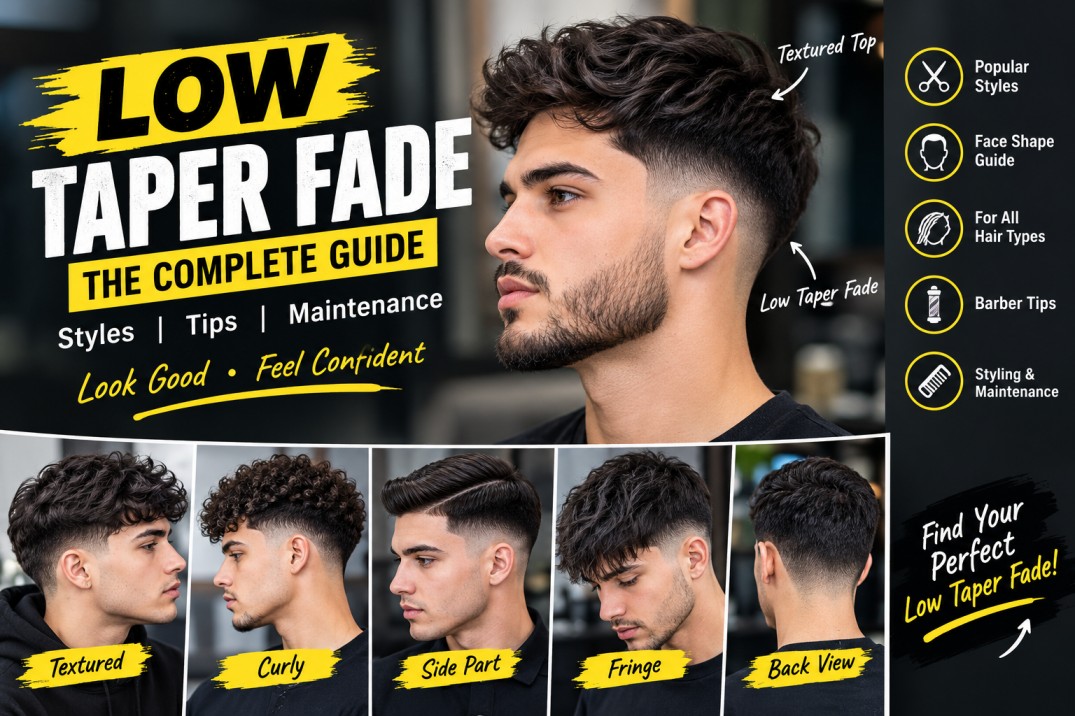
One advantage of the low taper fade is its compatibility with different hairstyles. Clients can combine the taper with a textured crop, fringe, quiff, comb-over, slick-back, curls, waves, coils, or longer natural hair. The haircut changes dramatically depending on the top style while the low perimeter blend remains the foundation.
For a conservative appearance, pair the taper with a neat side part or comb-over. For a contemporary appearance, textured hair, messy volume, curls, or a forward fringe can provide more personality. Barbers should consider the client’s hair density, growth pattern, styling routine, and workplace requirements before recommending the top length.
- Low taper with curls
- Textured crop
- Side-part taper
- Slick-back taper
- Tapered quiff
- Wavy taper
- Taper with fringe
- Taper with waves
Low Taper Fade for Different Hair Types
A low taper fade can work particularly well across straight, wavy, curly, and coily hair because the barber can modify the blend without dramatically changing the texture on top. With curly hair, keeping the fade low helps preserve curl volume and prevents excessive removal of the natural shape.
Straight hair often benefits from texture or controlled volume on top, while wavy hair can be allowed to follow its natural movement. For coily or tightly curled hair, careful clipper work around the perimeter can produce a crisp silhouette while retaining the natural texture above the taper.
- Straight hair
- Wavy hair
- Curly hair
- Coily hair
- Thick hair
- Fine hair
- Dense hair
- Textured hair
Choosing a Low Taper for Your Face Shape
Face shape should influence the overall haircut, particularly the length and volume left on top. A low taper is already relatively adaptable because it does not remove excessive hair from the upper sides. Clients with rounder faces may benefit from additional height or texture, while longer faces can work well with moderate volume and controlled sides.
Oval and square faces are especially flexible because many top styles complement their natural proportions. Rather than following rigid face-shape rules, an experienced barber should evaluate facial proportions, hairline position, crown behavior, and personal styling preferences before determining the final shape.
- Oval face
- Round face
- Square face
- Oblong face
- Heart-shaped face
- Diamond face
- Height on top
- Facial proportions
How Barbers Create a Low Taper Fade
A professional low taper begins with a clear plan for the blend height. The barber establishes the lowest section around the sideburns and neckline, then progressively works through different lengths to remove visible lines. Guard selection varies according to hair density, texture, desired contrast, and the client’s preferred finish.
The most important element is not simply removing hair but creating a seamless gradient. Clippers, adjustable blades, guards, clipper-over-comb, and scissor techniques may all be used. The barber should repeatedly check both sides for symmetry and inspect the blend under different lighting before completing the outline.
- Establish fade height
- Detail sideburns
- Blend short areas
- Use clipper guards
- Remove visible lines
- Check symmetry
- Refine the neckline
- Detail the edges
How to Ask Your Barber for a Low Taper Fade
The easiest way to communicate the haircut is to say that you want a low taper around the sideburns and neckline, while specifying how short you want the lowest point. If you want a skin finish, say so. If you prefer some visible stubble, request a #0.5 or #1-style finish according to your barber’s available tools.
Also explain what you want to keep on top. For example, you might request a textured crop, curls, longer fringe, comb-over, or natural volume. A reference photograph is especially useful because terminology can vary between barbers and regions. Clear communication is often the difference between the haircut you imagined and the haircut you receive.
- Say “low taper”
- Specify fade height
- Explain top length
- Choose skin or stubble
- Mention your hair texture
- Describe neckline preference
- Bring a reference photo
- Confirm before cutting
Low Taper Fade Maintenance and Styling
A low taper fade is relatively easy to maintain because the blend occupies a smaller area than many higher fades. For a consistently sharp appearance, many clients refresh the haircut approximately every two to four weeks, although growth rate and personal preference determine the ideal schedule.
Between barber appointments, keep the hair clean and use styling products appropriate for your hair type. Avoid excessive product buildup, and maintain the top according to its intended style. When the taper grows out, resist repeatedly cutting the edges yourself unless you understand the original blend; uneven DIY trimming can make the next professional correction more difficult.
- Trim every 2–4 weeks
- Shampoo appropriately
- Condition dry hair
- Use suitable styling products
- Brush or comb regularly
- Keep edges clean
- Protect natural texture
- Schedule professional touch-ups
Final Thoughts: Is a Low Taper Fade Right for You?
The low taper fade succeeds because it combines precision, versatility, and restraint. It cleans up the areas that most quickly make a haircut look untidy while preserving enough length to create numerous hairstyles. Whether you prefer curls, waves, textured hair, a classic comb-over, or a modern messy finish, the low taper provides a dependable foundation.
For modern barbers, the style demonstrates the importance of controlled graduation, symmetry, consultation, and personalized design. For clients, the most important lesson is simple: do not rely on the haircut name alone. Explain the fade height, desired shortest length, top style, and neckline, then use a reference image when possible. That approach produces a more predictable and personalized result.
- Versatile haircut
- Professional appearance
- Modern aesthetic
- Low visual contrast
- Works with many textures
- Multiple top styles
- Easy to personalize
- Beginner-friendly choice
Quick FAQ
Is a low taper fade good for beginners?
Yes. It is a relatively forgiving choice for someone getting their first fade because the blend remains low and preserves more hair on the sides.
How long does a low taper fade last?
A sharp appearance commonly lasts around two to four weeks, depending on individual hair growth and how precise you want the haircut to remain.
Is a low taper fade professional?
Yes. Its subtle transition can look polished enough for professional environments while still providing a contemporary haircut.
Can you get a low taper fade with curly hair?
Absolutely. The low placement can clean the perimeter while allowing the natural curls and volume on top to remain prominent.
What should I tell my barber?
Ask for a low taper around the sideburns and neckline, explain how short you want the lowest section, and specify how you want the top styled. A reference image can eliminate ambiguity.